
Mastering Fire Alarm Systems & Project Design
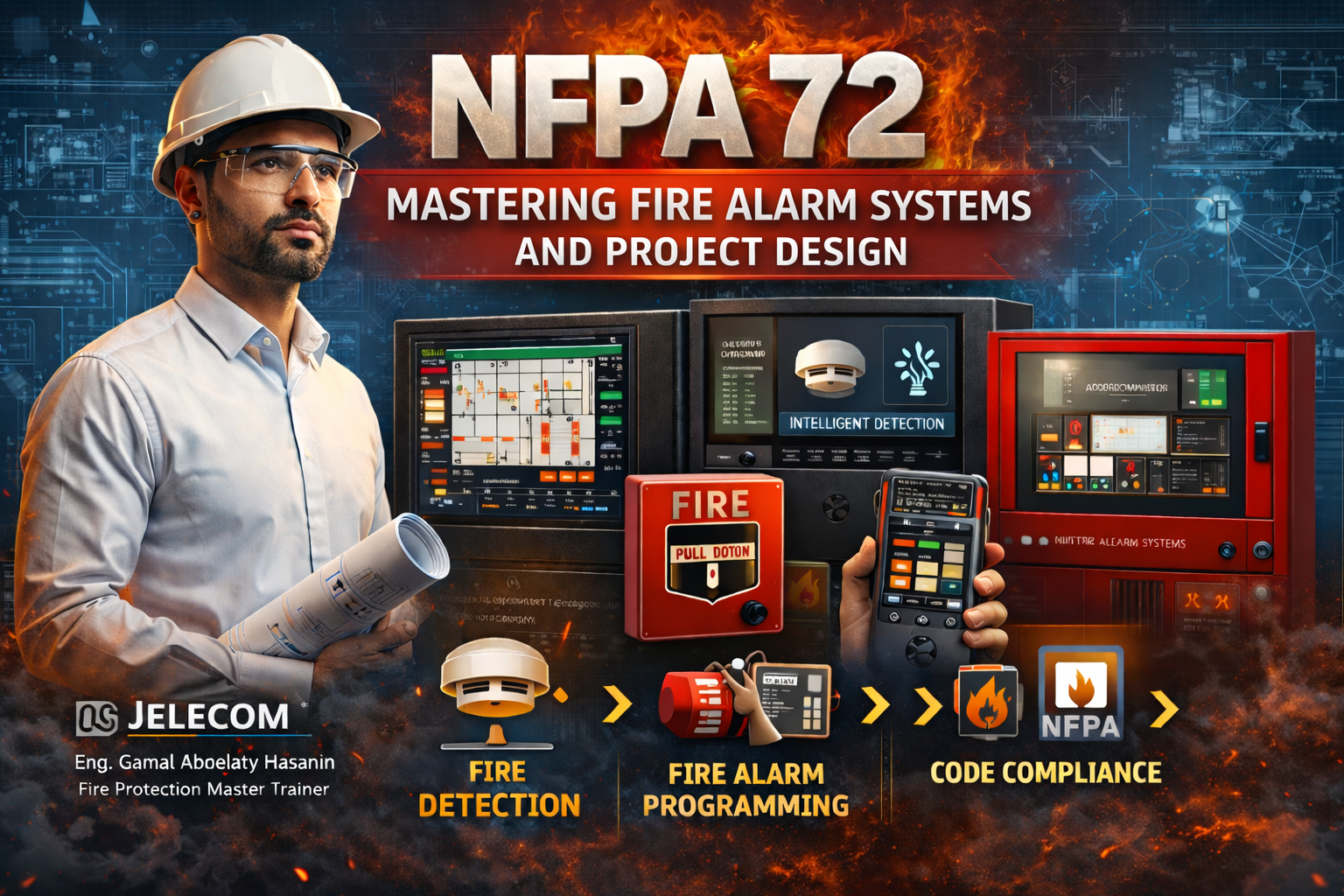
Fire Alarm Training Diploma
According to NFPA 72 and NFPA 101
Professional Fire Alarm Projects, Installation, Programming, Interfacing and Technical Office Training
| Training Provider | JELECOM Engineering & Technical Training Center |
| Program Format | Three progressive training levels |
| Total Duration | 90 Training Hours / 30 Lectures |
| Main Codes and Standards | NFPA 72, NFPA 101, NFPA 2001, BS 5839, EN 54, Egyptian Code |
| Program Focus | Fire alarm design, installation, commissioning, programming, troubleshooting, interfacing and project documentation |
Program Overview
The JELECOM Fire Alarm Training Diploma is a professional, practical and project-oriented training program designed to qualify engineers and technicians to work confidently in fire alarm systems, addressable systems, intelligent fire alarm projects, system programming, field installation, troubleshooting and technical office documentation. The diploma also explains fire alarm interfacing with HVAC, elevators, ATS, power panels, access control, PLC, DCS, SCADA and BMS systems.
Target Audience
- Electrical engineers working in fire alarm, light current, MEP and safety systems.
- Electrical maintenance technicians and tradespeople in industrial, commercial and institutional facilities.
- Instrumentation and control engineers who need fire alarm interface knowledge.
- Consultants, technical office engineers, contractors and project engineers involved in fire alarm projects.
Diploma Structure
| Level | Title | Duration | Main Focus |
| Level 1 | Fire Alarm Basic Level | 30 Hours / 10 Lectures | NFPA 72, detectors, conventional systems, design and installation fundamentals |
| Level 2 | Fire Alarm Advanced Level | 30 Hours / 10 Lectures | Addressable systems, intelligent fire alarm projects, NFPA 101 applications, installation networks and interfacing |
| Level 3 | Fire Alarm Professional Level | 30 Hours / 10 Lectures | Fire matrix, programming, maintenance, technical office and suppression systems |
LEVEL 1 – FIRE ALARM BASIC LEVEL
Duration: 30 Hours / 10 Lectures
Main Objective: To build a strong foundation in fire alarm codes, detector technologies, conventional fire alarm systems, notification appliances, wiring principles, design basics, installation practices, testing and maintenance.
| Training Module | Core Topics |
| Codes, Standards and Approvals |
· Introduction to fire alarm systems and their role in life safety and property protection. · International standards and codes for fire alarm systems. · American Code: NFPA 72 – National Fire Alarm and Signaling Code. · British Standard: BS 5839. · European Standard: EN 54. · Egyptian Code for fire alarm systems. · Accreditation and approval bodies: UL, ULC, FM, LPCB and VdS. · Fire alarm system vendor list and market overview. |
| Smoke Detection Systems |
· Smoke detectors and their operating principles. · Photoelectric smoke detectors: coverage, spacing, installation, testing and maintenance. · Applications on flat ceilings, sloped ceilings, suspended ceilings and raised floors. · Beam smoke detectors and their main applications. · Aspirating smoke detection systems. · Duct smoke detectors and HVAC-related applications. |
| Heat, Gas and Flame Detection Systems |
· Heat detectors: fixed temperature and rate-of-rise types. · Linear heat detection systems and cable applications. · Rate anticipation heat detectors. · Gas detectors for toxic gases, asphyxiant gases and flammable gases. · Low-density, equi-density and high-density gas detector applications. · Flame detectors: IR, UV and combined UV/IR technologies. |
| Manual Initiating Devices |
· Manual call point types: single action, dual action, key-operated and break-glass units. · Manual call point standards, spacing, installation, testing and maintenance. · Practical rules for manual fire alarm activation and location selection. |
| Conventional Fire Alarm Systems |
· Conventional fire alarm control panels. · Conventional zones and alarm circuits. · Sounder circuit applications. · Basic wiring, supervision and zone identification. |
| Notification Appliances and Calculations |
· Fire alarm sounders, flashers and speakers. · NAC voltage drop calculation. · Flasher candela calculation. · Fire alarm speakers integrated with public address systems. |
LEVEL 2 – FIRE ALARM ADVANCED LEVEL
Duration: 30 Hours / 10 Lectures
Main Objective: To qualify trainees to design, install, configure, test and troubleshoot addressable and intelligent fire alarm systems, and to understand fire alarm applications for different occupancies according to NFPA 101 and related project requirements.
| Training Module | Core Topics |
| Addressable Fire Alarm Systems |
· Addressable fire alarm control panel architecture. · Major components of addressable control panels. · Signaling Line Circuit (SLC) concepts. · Loop data communication and device polling. · Polling time, loop interrupt, loop maximum distance and loop resistance. · Loop current, loop protection, open-circuit conditions and short-circuit conditions. |
| Detector Addressing and Device Numbering |
· DIP switch addressing. · XPERT cards. · Rotary switch addressing. · Handheld programmers. · Auto-learn procedures and device discovery. |
| Addressable Detectors and Modules |
· Addressable smoke detectors, heat detectors and multicriteria detectors. · Addressable beam detectors and addressable duct detectors. · Linear heat detector wiring to addressable FACP. · Monitor modules, zone modules and input modules. · Control modules, signal modules and output modules. · Relay modules, input/output modules and transponders. · Isolator modules and fault modules. |
| Annunciators, Networking and BMS Interface |
· LED, LCD, mimic and graphic annunciators. · RS485 networking, fiber networking and IP networking. · BACnet modules and BACnet interface. · Addressable fire alarm control panel integration with BMS systems. |
| NFPA 101 Occupancy Applications |
· Assembly occupancies: theaters, cinemas, bus stations and train stations. · Industrial occupancies. · Storage occupancies. · Business occupancies. · Hotels and lodging facilities. · Educational occupancies. · Mercantile occupancies. |
| Fire Alarm Installation Network |
· Fire alarm boxes: pull boxes, back boxes and junction boxes. · Fire alarm conduits and pipes: PVC and EMT. · Buried networks: pipes, boxes and cables. · Exposed networks: pipes, boxes and cables. · Fire alarm cable standards, installation, testing and maintenance. · Fire-retardant and fire-resistant cables: Cat CWZ, PH30, PH60 and PH120. · Fire alarm armored cables. · Fire alarm control panel troubleshooting and maintenance. · Fire alarm network faults and maintenance. · NFPA wiring styles: Class A and Class B. |
| Fire Alarm Interfacing |
· Interfacing with fire water pump systems. · Interfacing with electrical power units and ATS systems. · Interfacing with elevators. · Interfacing with smoke management systems. · Interfacing with HVAC fans and fire/smoke dampers. · Interfacing with access control and security systems. · Interfacing with mass notification systems. · Monitoring of fire extinguishing systems. · Interfacing with voice alarm and emergency telephone systems. · Interfacing with BMS systems. |
LEVEL 3 – FIRE ALARM PROFESSIONAL LEVEL
Duration: 30 Hours / 10 Lectures
Main Objective: To develop professional capability in fire alarm cause-and-effect matrix preparation, addressable and intelligent panel programming, maintenance, project technical office deliverables, shop drawings, riser diagrams and integration with fire suppression systems.
| Training Module | Core Topics |
| Fire Matrix and Programming Preparation |
· Preparation of the fire alarm cause-and-effect matrix. · Preparation of device lists and Excel sheets. · Alarm, supervisory, trouble and control signal philosophy. · Input/output logic coordination with mechanical, electrical and life safety systems. |
| Fire Alarm Control Panel Programming and Maintenance |
· Addressable FACP programming. · Addressable Simplex programming and maintenance. · Intelligent Notifier programming and maintenance. · Notifier programming and maintenance. · Simplex programming and maintenance. · Edwards programming and maintenance. · Testing, fault diagnosis and maintenance strategies for addressable and intelligent panels. |
| Fire Alarm Projects Technical Office |
· Fire alarm system projects including shop drawings and riser diagrams. · Fire alarm system design for banks. · Fire alarm system design for warehouses. · Fire alarm system design for hospitals. · Fire alarm system design for factories. · Fire alarm system design for schools. · Fire alarm system design for hotels. · Fire alarm system design for malls. · Fire alarm systems for cinemas and theaters. · Fire alarm systems for universities. · Fire alarm systems for high-rise buildings. |
| Fire Suppression Systems Interface and Design Awareness |
· NFPA fire suppression codes overview. · Introduction to fire suppression systems. · Fire suppression systems using FM-200. · Fire suppression systems using CO2. · Fire suppression systems using NOVEC 1230 / FK-5-1-12. · NFPA 2001 clean agent system concepts and fire alarm release interface. |
Expected Learning Outcomes
- Understand the technical philosophy of fire alarm systems and their role in life safety engineering.
- Select and apply the correct initiating devices, notification appliances and control interfaces for different occupancies.
- Design conventional, addressable and intelligent fire alarm systems according to project requirements.
- Prepare practical fire alarm documentation including device lists, riser diagrams, shop drawings and cause-and-effect matrices.
- Perform troubleshooting, maintenance and basic programming for leading fire alarm control panels.
- Coordinate fire alarm systems with HVAC, elevators, power systems, access control, BMS and fire suppression systems.
if you would like to register, kindly press here and fill your information . . .
Jelecom Egypt
Jelecom is an Egyptian Company which has professional Engineers for Engineering Projects and it provides Technical Training and Solutions for both Engineers and Technicians in Industry & Academy
Contact Us
🗺️Address:
Building No. 73, Ramsis Street, downtown, in front of the High Court, Gamal Abdel Nasser Metro – Cairo, Egypt.
73 ش رمسيس الدور الثانى أمام دار القضاء العالي محطة مترو جمال عبدالناصر - وسط البلد - القاهرة
📱Tel ( For Training ):
01011981001 - 02 25777 134
01022612092 - 02 25777 135
01022612094 - 02 25777 137
01022612095 - 02 25777 139
📱Tel ( For Sales ):
01001605695
01008636386
01000480103
01000480104
📧E-Mail :
info@jelecom.com